

The Many Faces of Mexico City
A luxurious sojourn in the city brimming with unique restaurants and bars, and a vibrant art and fashion scene.
The Ritz-Carlton, Mexico City
No matter the time of day, Mexico City pulses with energy as if the streets themselves are alive, blood coursing through their veins, hearts beating like a chorus of drums. There is a vibrancy here that seeps into everything: the food, the drinks, the art, the architecture. Roads are jammed with cars, honking and swerving, the traffic surging and slowing in a great example of organized chaos. Locals huddle around street vendors selling fresh tacos and tortas and fruits sprinkled with tajin, their scents wafting through the warm air, drawing passersby into their embrace.
At night, the city is blanketed in a sea of red brake lights: the scene of people off to their homes or their night shifts or their favourite restaurants. The streets stretch out in seemingly every direction, but they are flanked by towering mountain ranges: the Sierra de Guadalupe, Monte Alto and Monte Bajo, and Sierra de las Cruces.
Mexico City is a place that can be discovered again and again—a place that reveals itself the more one cares to dig. Even those who live here have trouble keeping pace, as new restaurants and boutiques seem to open in a blink. Each visit can feel like the very first time.
The Ritz-Carlton, Mexico City
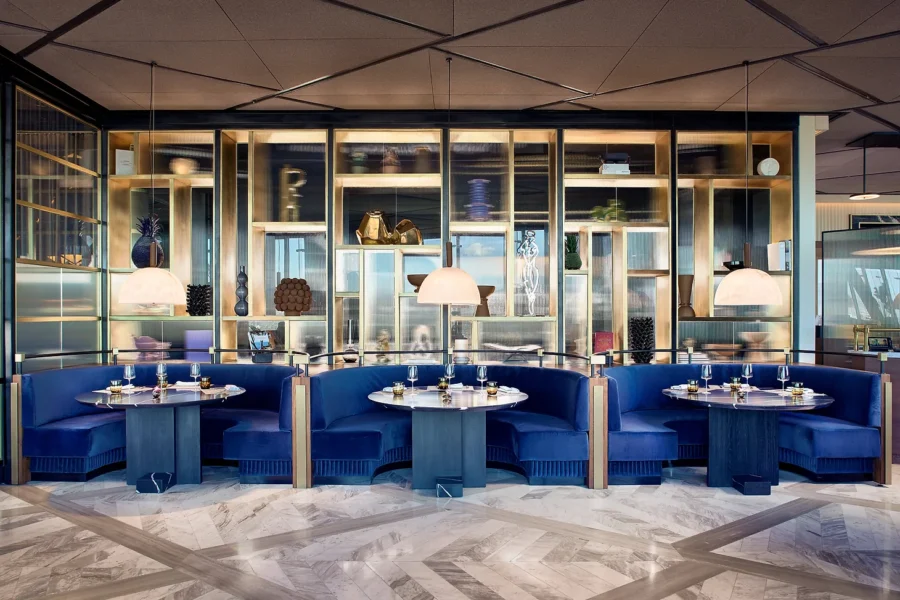
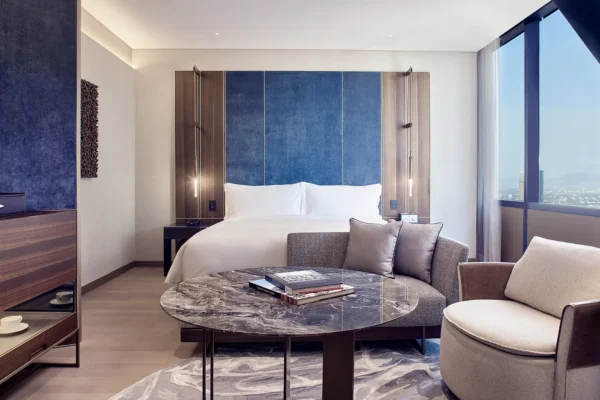
Rising high above Chapultepec Park lies The Ritz-Carlton, Mexico City, a 58-storey tower on the lively Paseo de la Reforma. Here, guest rooms feature sweeping, floor-to-ceiling views of the bustling city down below, with a private patio enclosed in glass for basking in the glorious Mexican sun. With a swish, contemporary design of dark blues and accents of gold, the hotel—a popular place for Formula 1 drivers during the Mexican Grand Prix—is pure urban luxury.
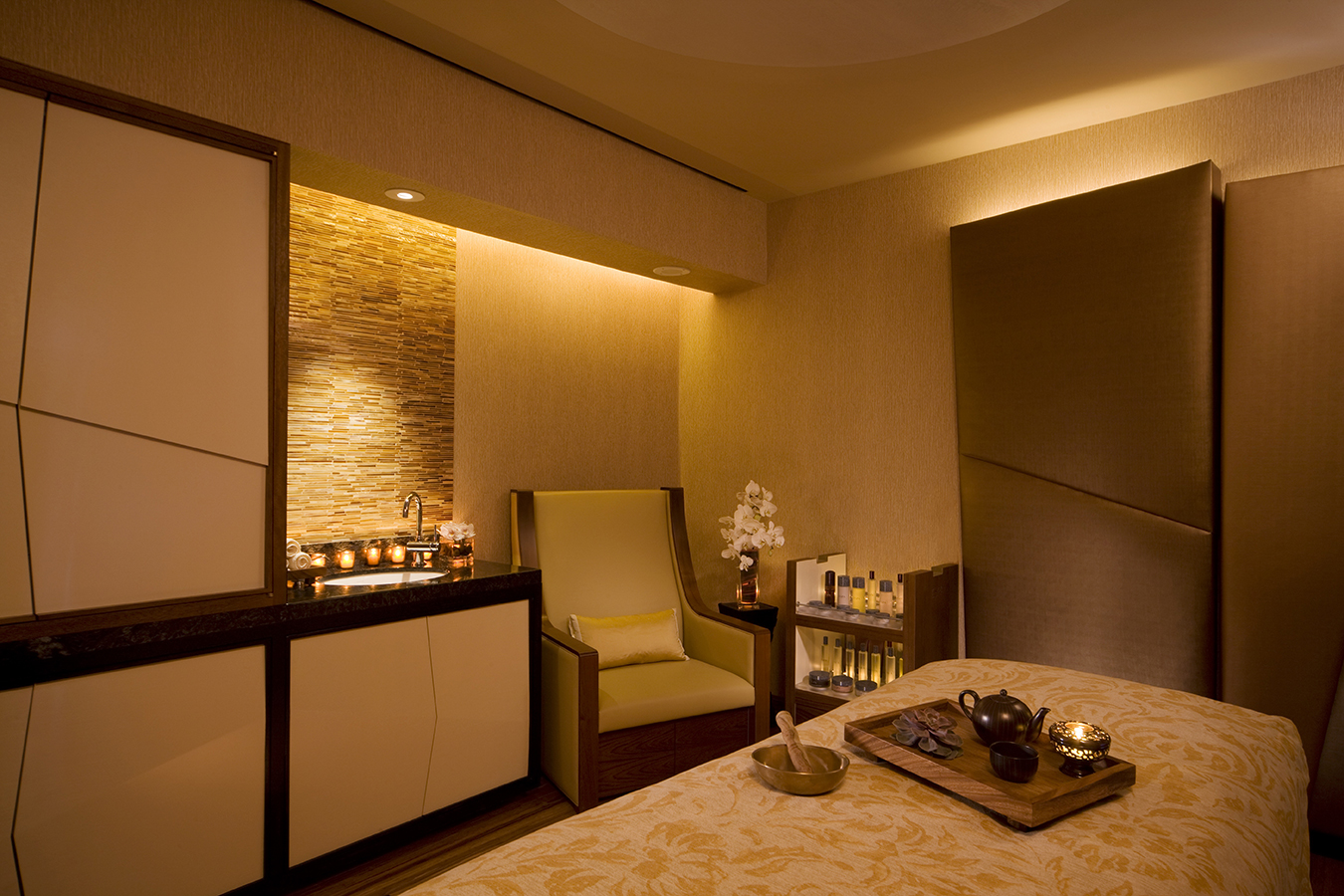
Those coming off of a long flight can indulge in the spa’s Timeless Capsule: a massage treatment, either for the scalp or feet, in a zero-gravity chair using technology developed by NASA. Being wrapped in a warm blanket with one’s feet in the air leads to a sense of weightlessness that makes time slow to a molasses-like state.
Afterward, it’s easy to float upstairs to Carlotta Reforma, The Ritz-Carlton’s cocktail bar for dirty gin martinis and panoramic views of the city. In the adjoining restaurant, Samos Sabores Míos, Mexican classics such as eggs divorcidados (smothered in both green and red salsa) with plantain and Mexican sausage provide a saucy, hearty breakfast, while dinner includes familiar dishes with Mexican twists: a cauliflower “steak” baked in a crust of olives, fried capers, guindilla peppers, and sun-dried tomato; and octopus with grilled baby corn, confit potatoes, and an addictive green tomato sauce.
The St. Regis Mexico City

The St. Regis Mexico City
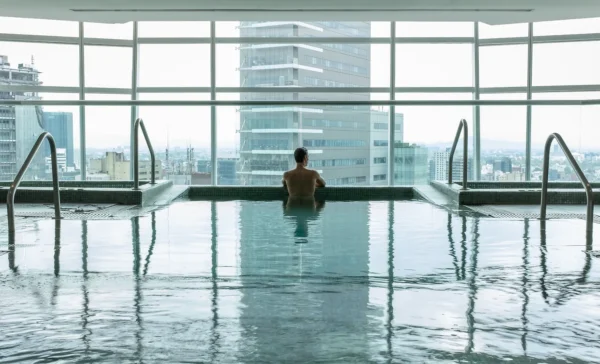
Equally impressive is The St. Regis Mexico City, just a five-minute walk from the Ritz down Paseo de la Reforma. The long, bustling thoroughfare is dotted with traffic circles, each more majestic than the last thanks to a series of regal statues and fountains. Close to The St. Regis is the Fountain of Diana the Huntress: a two-ton cast-bronze sculpture depicting a woman holding a bow, her back arm bent as if she has just released an arrow. And indeed, those who look closely will notice that she is not holding an arrow—instead, it can be found “stuck” in a nearby building.
Paseo de la Reforma is also a popular place from which to watch the city’s vibrant Dia de los Muertos parade every year in early November. Despite its prominence today, the parade has a James Bond film to thank for its existence. After 2015’s Spectre depicted a mesmerizing scene in which Bond (played by Daniel Craig) bobs in and out of a riotous parade, the city decided to launch one—an impressive example of life imitating art.
At The St. Regis, suites are pure opulence, with the classic St. Regis motif of sparkling surfaces and rich textures. The King Kole Bar—one of only two in the world, the other in the original St. Regis in New York—offers the ideal perch from which to watch the parade. But even those who visit before or after Day of the Dead will find reasons to love it here. Every St. Regis cocktail bar has its own version of the bloody mary, and Mexico City’s is the sumptuous sangrita maría, which is made with mezcal and a special Mexican salsa slow-cooked with tomatoes and spices. It is complex and richly flavoured—a surefire upgrade of the original.
At the hotel’s Diana restaurant, Mexican breakfast may include huevos cazuela: an egg casserole with fragrant and layered pasillo salsa. Indulge, too, in Mexican hot chocolate, made simply with ground, toasted cacao beans and a bit of sugar.
Chapultepec Castle. Photo by Sara Harowitz
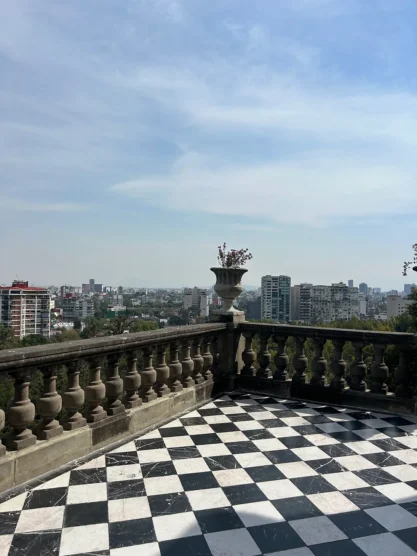
Both hotels are centrally located just steps from the expansive Chapultepec Park, where wanderers will find Chapultepec Castle: the former residence of multiple presidents dating back to 1825. Now a museum, it offers a glimpse into Mexico’s past through its detailed exhibits and palatial architecture. Also not to be missed for architecture fans are the Palacio de Bellas Artes, a stunning marble-clad theatre, and the beautiful Palacio Postal.
From there, it’s a short walk to the trendy neighbourhoods of Condesa and Roma Norte. Personal fragrance aficionados will not want to miss a stop at Xinu: a high-end perfume shop with three locations around the city, though its Juárez outpost is perhaps most impressive. For the home, Laguna Cyprien in Condesa offers a range of all-natural fragrances in the form of room sprays, reed diffusers, essential oil blends, hand soaps, and body creams.
The beauty of shopping in Mexico City is just that: the sheer beauty. Each store is a world unto its own, with thoughtful, contemporary, immersive design making every experience feel singular. There is a thriving art and fashion scene here, meaning that stumbling upon a boutique could reveal a new favourite brand. Made-in-Mexico Amor & Rosas reinvents traditional Mexican iconography for the contemporary wearer, while Cardón sells a selection of Mexican and Latin American brands. For art, Mooni‘s multiple locations showcase emerging modern Mexican talent.
Eating is its own thrill of discovery, with a taco stand on seemingly every corner, each more tantilizing than the last. Tacos de la Ciudad is a cheerful, blue-and-green-checkered place for chorizo and al pastor. For something sweet, El Moro, which dates back to 1935, serves hot and perfectly crispy churros.
Just as memorable is Mexico City’s cocktail scene. The number-two entry on the World’s 50 Best Bars list (and number one on the North American list) is here, and it is worthy of its continued praise. Located in an unassuming hotel, Handshake is a fast-paced cocktail mecca where every guest is greeted with a boisterous “Bienvenidos!” from the staff. Start with a mini martini (as cute as it sounds), and then move on to one of the full-sized options, from the mezcal negroni to the olive oil gimlet (an inspired take on a martini) to the Mexi-Thai (an alcoholic riff on tom yum soup that is as inventive as it is delicious).
Seatings at Handshake are capped at 90 minutes—that’s how popular it is—so afterward, consider a stop at the Italian-style Bar Mauro, where the Garibaldillo tastes delightfully like an adult version of an Orange Julius. From there, head to Fo+Ma, short for Form + Matter: a science experiment moonlighting as a cocktail bar, where each drink is a mix of imagination and wizardry. Take, for example, the Golden Milk: inspired by the flavours of India, it mixes Johnnie Walker Black with turmeric, honey, coconut, pepper, ginger, and cinnamon in a drink that feels at once distinct and familiar. It’s served with a chunk of sweet honeycomb to crunch in between sips. Or there is the M&M: an old fashioned made with mezcal that has been infused with mole.
One Fo+Ma employee, a jolly fellow whose job is to show guests to their seats, admitted that he first came to the bar as a patron. But after one sip of the Martini Fromage—a vodka martini infused with blue cheese, apple, and tomato—he was hooked.
“I said, ‘I have to work here,’” he recalled. That is Mexico City in a nutshell: a passion for beauty and creativity that takes hold and does not let go.