


The Box Is Officially Back
Behind the wheels of the 2025 Toyota Land Cruiser and 2025 Lexus GX 550.
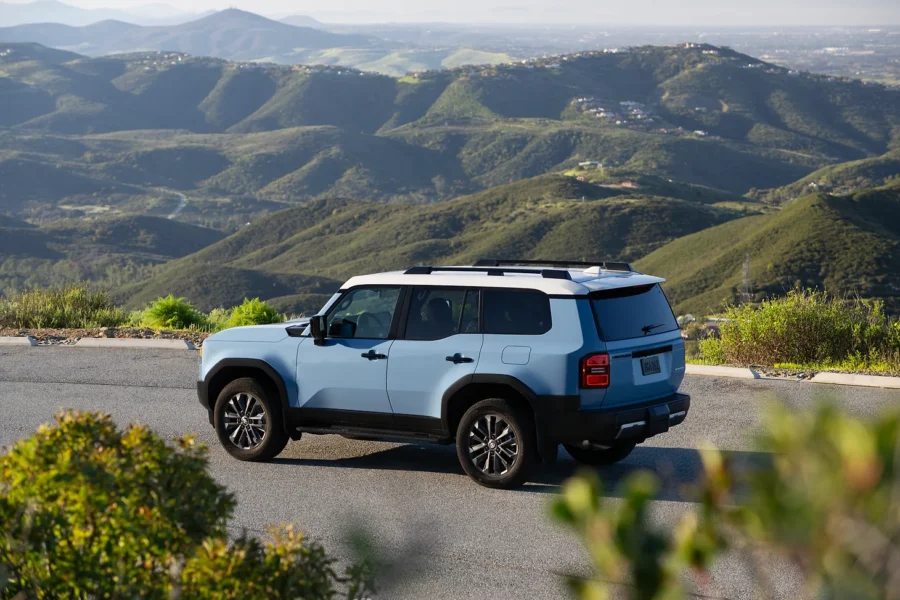
2025 Toyota Land Cruiser
The box is back. Not as some form of nostalgia but as a deliberate rejection of the softened, wind-tunnelled sameness that has defined the SUV landscape for a decade. Straight edges have returned with intent. Upright glass once again signals visibility rather than design theatre.
The revival has been led convincingly by machines that take shape seriously: the Land Rover Defender, reborn with architectural confidence; the Ford Bronco, unapologetically muddy; the Mercedes-Benz G-Class, still proving that conviction ages better than fashion.
Proportion and purpose, it turns out, are not trends. They are principles. Into this newly squared frame step two closely related but carefully differentiated propositions: the Toyota Land Cruiser and the Lexus GX 550.
At first glance, they read like siblings cut from the same steel—because, fundamentally, they are. Both are built on the Toyota GA-F platform, a modern body-on-frame architecture engineered for rigidity, durability, and genuine off-road work. This is not a lifestyle platform with rugged cues applied after the fact. It is the same structural foundation that underpins Toyota’s most serious trucks and SUVs worldwide. The boxy silhouettes are not stylistic indulgences. They are structural truths, rendered visible.
Look closer, and the divergence begins.
The reenvisioned Land Cruiser is the more philosophically interesting of the two. Long associated with global expeditions and mechanical indifference to hardship, it reentered the Canadian market pared back and recalibrated. Gone is the outsized V8 presence of its final iteration. In its place sits a 2.4-litre turbocharged four-cylinder hybrid powertrain, which produces a combined 326 horsepower and 465 lb-ft of torque. On paper, the numbers reassure. On the road, the delivery is intentionally restrained.


Power arrives early and smoothly but without ceremony. The electric motor fills gaps seamlessly and, in doing so, removes any sense of surge. Acceleration is competent rather than compelling, effective rather than expressive. Driven back-to-back with the Lexus, the Land Cruiser can feel quieter than expected, its output carefully managed, its eight-speed automatic more interested in composure than urgency. This is torque tuned for terrain and longevity, not for theatre.
This tuning reflects a contemporary interpretation of toughness. Efficiency here is not an apology—it’s an advantage. Full-time four-wheel drive and a chassis calibrated for control over character make the Land Cruiser feel engineered to work consistently rather than impress intermittently. Inside, the design language follows suit. Controls are physical, logical, and sized for real use. Materials feel chosen for endurance rather than impression. The atmosphere is calm, almost austere, as if the vehicle is quietly waiting to be relied upon.
The Lexus GX 550 takes the same GA-F foundation and weaves a different story. Where the Land Cruiser is restrained, the GX is assertive. Its 3.4-litre twin-turbocharged V6 produces 349 horsepower and 479 lb-ft of torque, delivered through a 10-speed automatic transmission that feels perpetually alert. The numerical advantage is modest. The experiential gap is not.
Behind the wheel, the GX feels immediately more authoritative. Throttle response is sharper. Gear changes are more decisive. The sense of mass is matched by a willingness to move it with confidence. The engine makes itself known—not loudly, but clearly—signalling effort and intent. Where the Land Cruiser absorbs momentum quietly, the GX manages it with presence.
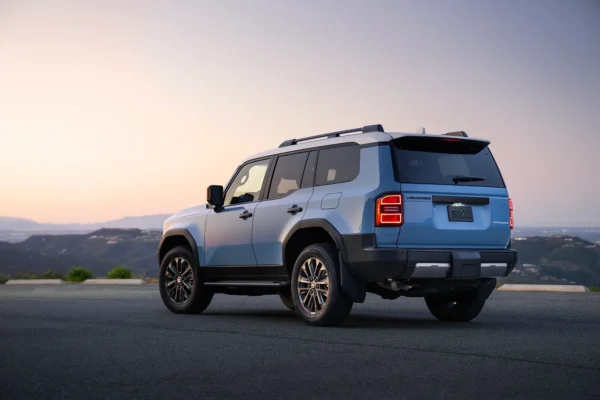
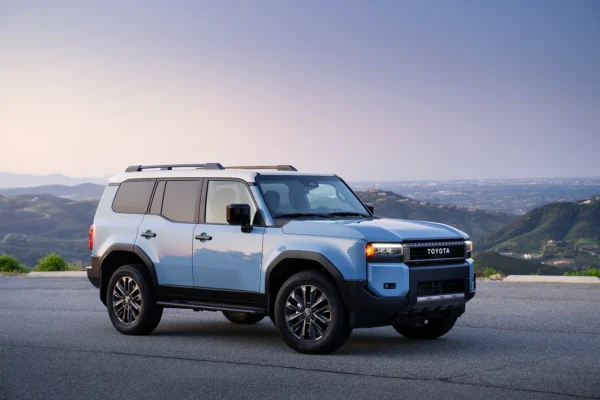
Lexus leans into that distinction unapologetically. The cabin is not luxurious when compared to other modern-day Lexus models, but it is quieter, richer, and more deliberately insulated than the Land Cruiser. The experience is less about exposure and more about command. This is not an SUV designed to prove itself. It assumes its capability and moves on.
The design of the Land Cruiser is almost architectural: flat planes, round headlamps a sense of visual order that suggests durability rather than dominance. The GX 550 wears its intent more loudly. Its interpretation of the Lexus grille introduces tension and drama into an otherwise upright form. It looks expensive because it is meant to be read that way.
On the road, the similarities return. Both vehicles feel substantial without being cumbersome. Steering is measured and on the light side. Ride quality absorbs imperfections without commentary. Off pavement, the shared hardware—low-range gearing, locking differentials, advanced traction systems—places them firmly in a specific subset of the modern SUV. These are not symbolic off-roaders. They are functional ones.
The difference between the two, ultimately, is philosophical. The Land Cruiser feels like a recommitment to Toyota’s original thesis: reliable, restrained, confident. The GX 550 refines the same capability through performance, isolation, and polish, rewarding the driver with a more immediate sense of power.
In an era increasingly defined by electrification and abstraction, these boxy SUVs make a quieter argument: that mass, shape and mechanical honesty still matter. Parked side by side, they resemble brothers. Not twins. More like siblings raised with the same values but very different expectations of how loudly those values should be expressed.